
Face Area Guide
Forehead
A calm guide to forehead and brow tension, with gentle relaxation-focused exercises.


Area overview
Area overview
The forehead is often where everyday expression and concentration show up first. The frontalis and brow muscles can become overactive during stress, screen use or focused work.
Face yoga for the forehead emphasizes slow awareness, softening and consistency rather than force.
Common appearance concerns
- Forehead tension
- Brow tightness
- Frowning habits
- Expression-line appearance
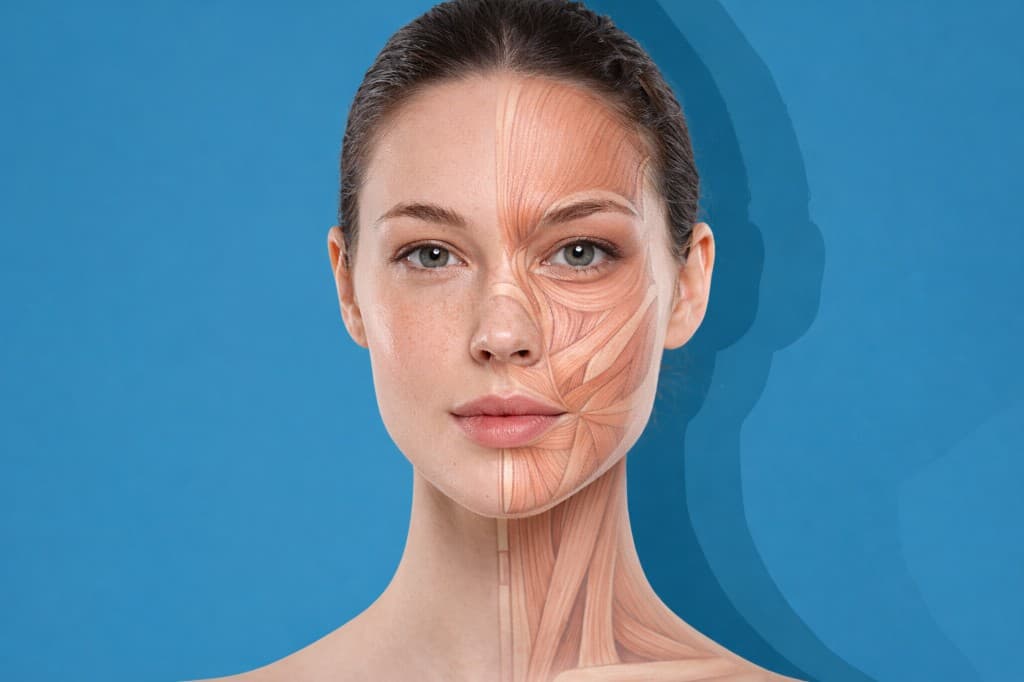
Muscles in this area
Muscles in this area
A simplified map of the muscle groups most often associated with this area, how they move and why Face Yo keeps the practice gentle.
Frontalis
The broad muscle across the forehead that raises the eyebrows.
Helps explain expression awareness and gentle release around the forehead, brows or eye area.
Corrugator supercilii
Small muscles between the brows involved in frowning.
Helps explain expression awareness and gentle release around the forehead, brows or eye area.
Procerus
A muscle at the top of the nose between the brows.
Relates to facial balance, expression and controlled activation through the central face.
Brow tension area
The region around the brows where everyday tension often gathers.
Helps explain expression awareness and gentle release around the forehead, brows or eye area.
Anatomical and science references
References help explain the anatomy and the current limits of facial-exercise research. The guided lesson itself lives inside the Face Yo app.
Learn the anatomy here. Practice the guided lesson in the app.
What to keep in mind
Muscle awareness
Gentle face yoga can help you notice and relax the muscles in this area.
Facial tension
Everyday stress can settle here; slow, guided movements may help release it.
Posture & daily habits
Screen time and posture influence how this area looks and feels.
Healthy-aging appearance
A consistent routine can be part of a calm, healthy-aging self-care habit.
Routine consistency
Short daily sessions matter far more than occasional intense ones.
Related exercises
Related routines
Follow this routine step by step in Face Yo.
How Face Yo helps
How Face Yo helps
What science says
What science says
Research on facial exercises is still developing. Some studies suggest that structured facial exercise routines may support facial appearance in selected groups, but more research is needed. Face Yo presents face yoga as a wellness routine, not a medical or cosmetic treatment.
Association of Facial Exercise With the Appearance of Aging
Key finding: After a 20-week facial exercise program, some participants reported a modest improvement in perceived facial fullness.
Limitations: Very small sample, no control group and self-selected participants — results cannot be generalized.
Common mistakes to avoid
Pressing too hard instead of using a gentle touch
Expecting immediate visible change rather than gradual progress
Practicing inconsistently
Holding unnecessary tension in the face
Skipping neck and posture awareness
Moving through exercises too quickly
Not following the guided instructions
A gentle note on safety
Frequently asked questions
What movement style is safest for the forehead?
Does posture really matter when training the forehead?
How often should I train the forehead each week?
When should I pause forehead practice?
Start your guided routine for this area
Download Face Yo and follow personalized face yoga exercises step by step.
Scan to download Face Yo